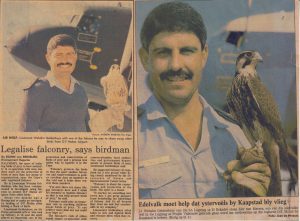
 Project Falconer attracted a lot of media attention, as being the first official SAAF research project involving falconry. Throughout all my media engagements, I campaigned for the legalization of falconry in the Cape Province, like this article in the Cape Argus. The vision and objective were to establish a falconry club that would serve as a vital development environment for falconers, ultimately enhancing regional aviation safety. This initiative, alongside Dr. Oettle’s efforts, aimed to create a formal structure for Cape falconry enthusiasts. Despite ongoing advocacy, the WCNCB initially resisted the concept of a falconry club. However, Project Falconer continued to yield valuable data, meticulously documenting ecological factors relevant to bird activity around airfields. A mid-project progress report was submitted, followed by discussions with SSO Flight Safety at Silvermine.
 A significant event on 23 May 1991 unknowingly and dramatically shifted the odds for falconry in the Western Cape. A VIP Falcon 50 jet, registration number ZS-CAQ commanded by Commandant SAS Potgieter on take-off at AFB Ysterplaat experienced a double bird strike. The Air Traffic Controllers on duty were Rob Russell and Andre van der Walt. Andre vectored the aircraft in, whilst Rob handled the emergency services for an emergency landing at DF Malan (Cape Town International Airport), for which he was awarded a Golden Certificate.
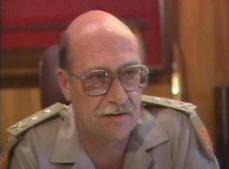 This bird strike resulted in the loss of two engines. The pax, General Kat Liebenberg, Chief of the Army, along with other key military personnel, elevated this bird strike and incident to the highest military levels. I was selected to form part of the board of inquiry regarding the birds and the threat of birds on military air bases. In this incident, seagulls were the cause. This catapulted aviation safety to the forefront. I was delegated to officially inform WCNCB that falconry would be implemented as a standard integrated division within the SSO Flight Safety Division at AFB Ysterplaat. The docex was officially submitted to WCNCB.