 Great Whites are distinguished by their robust, torpedo-shaped bodies, powerful tails capable of propelling them through water at speeds exceeding 56 kph, and a conical snout leading to a formidable mouth filled with rows of large, serrated, triangular teeth. These teeth, often numbering around 300 at any given time, are continuously replaced throughout the shark’s life. Adults can reach impressive sizes, typically averaging over 4 meters, with some reliably recorded individuals exceeding 6 meters and weighing over two tons. Their coloration – a stark countershading of dark grey or bronze on top and white underneath – provides excellent camouflage, making them difficult to spot from above against the darker depths and from below against the lighter surface.
Unlike most fish, Great Whites can maintain a body temperature significantly warmer than the surrounding water, particularly in their muscles, stomach, and brain. This is achieved through a specialized network of blood vessels called the “rete mirabile” (wonderful net), which acts as a counter-current heat exchanger. This warmth allows for faster muscle contraction, increased swimming speed and power, more efficient digestion, and the ability to inhabit cooler temperate waters where prey is abundant.
 Their sensory arsenal is extraordinary. They possess an acute sense of smell, capable of detecting a single drop of blood in millions of gallons of water. Their eyesight is well-developed, particularly for low-light conditions. Perhaps most famously, they possess ampullae of Lorenzini – gel-filled pores concentrated around their snout that detect the faint bioelectric fields generated by the muscle contractions of living animals, allowing them to locate hidden or buried prey.
Great White Sharks are migratory, found in cool, temperate coastal waters across the globe, with notable populations off the coasts of South Africa, Australia, New Zealand, California (USA), Mexico (Guadalupe Island), and the Mediterranean.
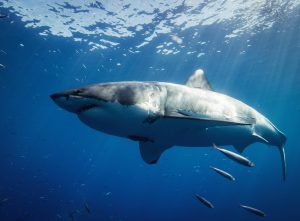 Their diet varies with age and size. Younger sharks primarily feed on fish, rays, and smaller sharks. As they mature and grow larger, their diet shifts to include marine mammals such as seals, sea lions, and occasionally small cetaceans (dolphins and porpoises), as well as scavenging on whale carcasses. Their hunting strategies are often characterized by powerful ambush attacks, striking prey from below with incredible speed and precision. The famous “breaching” behaviour, particularly seen off South Africa’s Seal Island, where sharks launch their entire bodies out of the water in pursuit of seals, is a spectacular testament to their power.
Reproduction in Great Whites is ovoviviparous, meaning eggs hatch within the mother’s body, and she gives birth to live, fully developed pups. Litter sizes are relatively small (2-10 pups), and gestation is long, estimated at 12-18 months. Pups are born large, around 1.2-1.5 meters, and are independent from birth. They reach sexual maturity late, typically between 10-15 years for males and 15-20 years for females, and are thought to have lifespans of 30-70 years or more. This slow reproductive rate makes their populations particularly vulnerable to depletion.