 Research indicates a fairly active falconry community as early as the 1950s. Mr. Roy Demont, who served as Chairman of the Natal Falconry Club from 1983 to 1986, began his involvement with Falconry in 1952 and joined the South African Falconry Club when it was established in 1953 under Rudi de Wet’s chairmanship. The SAFC also published a journal, “The South African Falconer,” of which Roy provided three back issues. One issue lists the names of 24 falconers, including Roy, and celebrates the club’s first anniversary on July 1, 1954.
 Many falconry clubs had short lifespans, often due to conflicts among their strongly individualistic members. As a result, falconry usually involved just the falconer and a few friends, a trend that largely continues today. Consequently, falconry is often overlooked in the social histories of countries unless it has broader societal significance (as in the Middle East) or is seen as a link to traditions. Neither of these conditions applies to Southern Africa, so there is little record of falconry activity before World War 2. A falconry club in South Africa is not a social club, instead, it is considered a legal person, whilst its members are natural persons.
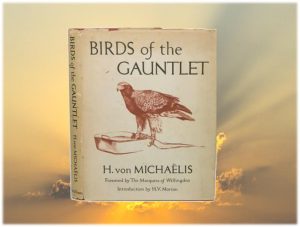 The earliest known record of falconry in southern Africa involves H. von Michaelis, a German immigrant who settled in the Cape Province in 1937 and published “Birds of the Gauntlet” in 1952. Rudi de Wet became involved in falconry in 1945 and joined the Transvaal Falconry Club in 1987. His interest in falconry was sparked by references he encountered while studying Chinese in preparation for missionary work in China. Rudi later founded the South African Falconry Club, the earliest documented formal club in South Africa.
 In 1955, the 16-year-old Paul Venter’s association with Carel van der Merwe, a student at the Johannesburg Art School, led him to meet fellow artists and falconry enthusiasts Ray Black and Roger Nielson. This introduction further connected him with another artist, Rudi de Wet.
 Before this formalization, in October 1964, Paul and Rudi initiated an informal nationwide group known as The Gauntlet and Lure. This unique association operated on an invitation-only basis, with no membership fees. Instead, active participation was maintained through contributions to the G&L newsletter – a testament to the community’s shared passion and knowledge. The Gauntlet and Lure fostered connection amongst falconers across South Africa until June 1973.